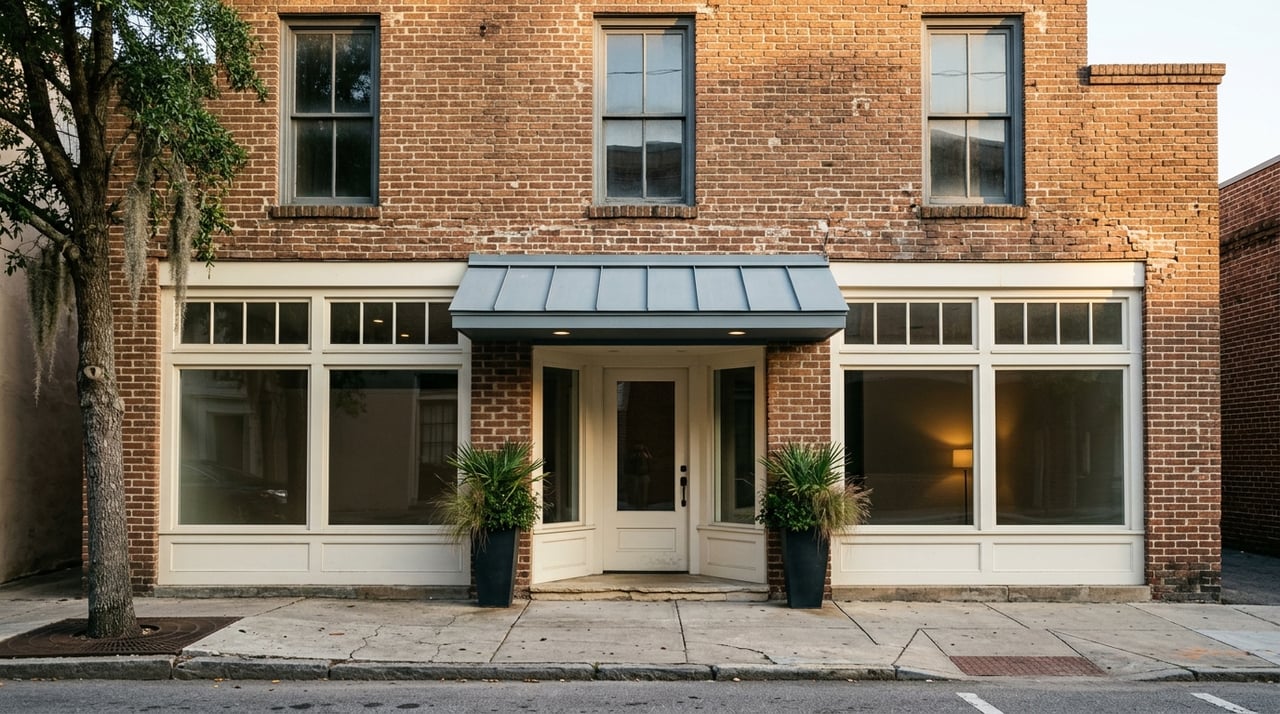
If you are looking at Brunswick storefronts as a small investor, one mistake can get expensive fast: assuming every retail location in town works the same way. In Brunswick, the historic, walkable downtown core operates very differently from the city’s larger auto-oriented corridors. If you understand those differences before you buy, you can make better calls on tenant fit, renovation scope, lease structure, and long-term income. Let’s dive in.
Brunswick Has Two Storefront Lanes
Brunswick’s small-storefront market breaks into two main investment lanes. One is the historic downtown and Old Town area around Newcastle Street and the waterfront. The other includes more auto-oriented corridor properties along Bay Street and Glynn Avenue.
According to the City of Brunswick Downtown Development Authority, downtown Brunswick is the city’s core commercial area, while Old Town is part of a National Register historic district. The city also treats Bay Street and Glynn Avenue as major corridors with different economic roles, which matters when you are evaluating visibility, access, and likely tenant demand.
That distinction is the starting point for almost every good investment decision here. A walkable historic storefront and a corridor retail site may both be “small commercial,” but they often support different users, face different building rules, and perform best under different business models.
Know the Local Demand Picture
Before you zero in on one property, it helps to understand the countywide business backdrop. The U.S. Census QuickFacts for Glynn County reports an estimated population of 86,540 as of July 1, 2024, median household income of $69,799, and $2.27 billion in retail sales in 2022.
The same source reports $895.3 million in accommodation and food service sales and 2,787 employer establishments in 2023. That points to a moderate-sized local economy with a mix of resident and visitor activity, not just one demand source.
Tourism also shapes the local business environment. The Golden Isles CVB is the official destination marketing organization for Glynn County, and Brunswick is positioned as the mainland city in that visitor network. For a storefront investor, that can matter if your property or tenant is tied to downtown traffic, waterfront activity, or travel-related spending.
Compare Newcastle, Bay, and Glynn
Newcastle Street and Old Town
Newcastle Street and nearby blocks are Brunswick’s historic commercial core. The city’s historic preservation materials explain that Old Town is a National Register historic district, and the commercial area along Newcastle Street has limited vacant land, which makes reuse and rehab more realistic than ground-up development in many cases.
If you like walkability, character, and mixed-use potential, this area may be the most interesting lane. It can support the kind of smaller users many investors want, such as coffee shops, boutiques, salons, or office and service tenants in a traditional storefront setting.
But historic-core investing usually comes with more design and review considerations. You are not just buying square footage. You are buying into a physical context where facade changes, storefront rhythm, and building character can directly affect your timeline and budget.
Bay Street
Bay Street serves a different role. The city’s Bay Street corridor study describes it as a 7.3-mile corridor from I-95 to US 17/Glynn Avenue and identifies it as a major freight and employment corridor as well as a gateway to downtown.
That tells you something important about site selection. Bay Street may offer visibility and functional access for certain businesses, but the same study notes that sidewalks exist while pedestrian connectivity is limited. In plain terms, some Bay Street properties may work better for users who depend more on vehicle access than on foot traffic.
Glynn Avenue
Glynn Avenue is also a gateway corridor, but the city’s framework takes a specific position on its role. The Glynn Avenue design guidelines say the corridor should become an activity center that complements downtown Brunswick rather than competes with it.
For investors, that means you should think about Glynn Avenue as its own environment, not a substitute for downtown. The tenant that thrives in a walkable Old Town storefront may not be the same tenant that performs best on a busier corridor site.
Zoning Can Shape Your Exit Strategy
For small storefront investing in Brunswick, some zoning districts matter more than others. The city’s zoning ordinance identifies MUCCH, OC, NC, GC, and HC as key labels for small commercial uses.
Here is the plain-English version:
- MUCCH supports a mixed-use downtown setting with commercial, office, and residential uses
- OC is geared toward business, office, institutional, public, and semi-public uses
- NC is neighborhood-oriented and allows small-scale shopping and service uses
- GC covers broader general business uses
- HC is intended for tourist, vacationer, trucker, and traveling-public uses on larger sites
The city ordinance also notes that the NC district limits floor space to 2,000 square feet per permitted use. That is a meaningful detail if you are evaluating a small neighborhood node and trying to picture the likely tenant pool.
In downtown settings, MUCCH stands out because the ordinance says off-street parking and loading areas are not required unless the Building Official requires them. That does not mean parking stops mattering, but it does support a more urban, pedestrian-oriented form than a typical strip layout.
This is why zoning should not be treated as a checkbox. It can influence tenant demand, renovation design, parking expectations, and even resale appeal when you eventually exit.
Historic Rules Can Affect Cost and Timing
If a property sits in Old Town or another historic district, exterior changes may require a Certificate of Appropriateness. The city’s historic preservation guidance emphasizes storefront rhythm, compatible massing, traditional materials, pedestrian-scaled streetscape elements, and preserving the historic character of downtown commercial blocks.
That does not make historic storefronts a bad investment. It just means your underwriting should reflect the approval path and the reality that certain upgrades may take more planning than they would on a standard corridor property.
In many cases, the better play in historic areas is thoughtful repositioning rather than heavy-handed redesign. Investors who understand the setting early are often better prepared to match renovation scope with the city’s expectations.
Do Not Ignore Permits and Fire Code
A deal can look solid on paper and still go sideways if you underestimate compliance work. In Brunswick, the Planning, Development & Codes department handles planning and zoning, building permits, code enforcement, and historic preservation, while the Development Review Team reviews building permits, variances, and conditional use applications weekly.
The city also accepts online applications for building, MEP, roofing, demolition, sign, and right-of-way permits. That is useful, but convenience does not remove the need for early due diligence.
The Fire Marshal’s Office may require a storefront to be brought up to current fire code before opening or reopening. Depending on the building and use, that can include exits, emergency lighting, extinguishers, alarms, sprinklers where required, and kitchen hood suppression.
If your property touches a state-owned highway right-of-way, access work such as curb cuts may also require GDOT approval. For small investors, these are the kinds of line items that can reshape both your timeline and your return.
Match the Tenant to the Corridor
One of the safest ways to evaluate a storefront is to ask not “What could go here?” but “What kind of tenant fits this location, zoning, and building form?” Based on the zoning district intents in Brunswick, local storefronts often fall into a few broad patterns.
- NC areas tend to fit neighborhood service uses
- OC areas often align with professional offices and public-facing service uses
- GC areas can support broader retail and service businesses
- HC areas are more geared to travel- and tourism-oriented users
- MUCCH and downtown mixed-use settings can support combinations like ground-floor retail with offices or apartments above
For many small investors, that translates into uses like coffee shops, boutiques, salons, clinics, accountants, attorneys, and other small service businesses rather than large-format retail. The goal is not to force a concept onto the property. The goal is to let the corridor and zoning help narrow the best-fit tenant profile.
Lease Structure Matters More Than Asking Rent
A storefront with a strong advertised rent can still disappoint if the lease is poorly structured. The Cornell Legal Information Institute explains the basic difference between gross, net, and triple-net leases.
In a gross lease, the tenant pays one set rent and the landlord covers many property expenses inside that rent. In a net lease, the tenant pays base rent plus some operating costs like taxes, insurance, utilities, or common area expenses. In a triple-net lease, the tenant typically pays rent plus taxes, insurance, and maintenance or CAM.
For a small investor, this is one of the biggest drivers of predictable income. You want to know which costs stay with you, which costs pass through to the tenant, and who handles major items like roof, HVAC, or parking lot work.
Use a Simple Income Screen First
You do not need a complicated model to screen a Brunswick storefront. A practical first pass is to start with gross rent, subtract expected vacancy and operating costs, and see what remains as net operating income.
HUD defines net operating income as the annual income remaining after operating costs and required reserve deposits. The key habit is to underwrite with realistic assumptions, not best-case hopes.
That means asking a few basic questions:
- What is the likely rent for this corridor and unit type?
- What vacancy should you assume between tenants?
- Which expenses will stay with the owner?
- What deferred maintenance could show up in year one?
- Will approvals or code upgrades delay income?
A good storefront investment is rarely about the prettiest building. It is about whether the property can produce dependable net income after real-world costs.
Build a Better Due Diligence Checklist
In Brunswick, a small investor should verify the same core items every time before making an offer. The local agencies are clear enough that you can build a solid checklist without overcomplicating it.
Start with these:
- Confirm zoning and permitted use
- Check whether the property is in a historic district
- Ask what permits are likely required for your plan
- Review possible fire-code upgrade needs
- Verify access issues, especially near major roads or state rights-of-way
- Consider whether the corridor is better for foot traffic, drive-by visibility, or mixed-use positioning
The city’s planning and development system gives you several official checkpoints, including Planning, Development & Codes, the Downtown Development Authority, the Historic Preservation Board, the Fire Marshal, and related engineering or development review staff when needed.
What This Means for Small Investors
Brunswick can offer real opportunity, but it rewards investors who stay disciplined. The strongest opportunities often come from choosing the right lane first, then matching the property to the right tenant, lease structure, and renovation plan.
If you want walkability, mixed-use character, and historic appeal, downtown and Old Town may be your lane. If you want more visibility and a more auto-oriented setting, Bay Street or Glynn Avenue may make more sense. Neither is automatically better. The right fit depends on your budget, risk tolerance, and business plan.
That is where local guidance helps. If you are weighing a Brunswick storefront, Chuck Hudson can help you evaluate location fit, due diligence priorities, and the on-the-ground factors that matter before you commit.
FAQs
What should small investors compare when buying Brunswick storefronts?
- Small investors should compare corridor type, zoning, historic status, likely tenant fit, lease structure, access, and expected code or permit costs before making an offer.
What makes downtown Brunswick storefronts different from Bay Street properties?
- Downtown Brunswick storefronts are generally more walkable and more likely to involve historic reuse and design review, while Bay Street properties are part of a major freight and employment corridor with more auto-oriented characteristics.
What zoning districts matter for Brunswick small storefront investments?
- The main zoning districts to review are MUCCH, OC, NC, GC, and HC, because each district supports a different mix of commercial, office, service, or travel-oriented uses.
What should investors know about historic storefronts in Brunswick?
- Investors should know that properties in Old Town or other historic areas may require a Certificate of Appropriateness for exterior changes and may need renovations that align with local design guidelines.
What expenses matter most when underwriting a Brunswick storefront?
- Beyond base rent, investors should review vacancy, taxes, insurance, utilities, maintenance, reserves, and responsibility for major items like HVAC, roof work, parking areas, and fire-code upgrades.
What local offices help with Brunswick storefront due diligence?
- Key local checkpoints include Planning, Development & Codes, the Development Review Team, the Fire Marshal, the Downtown Development Authority, the Historic Preservation Board, and, where access is involved, GDOT-related review.